Deezer built a fire alarm for a building it owns and is still billing the tenants

Deezer built a fire alarm for a building it owns and is still billing the tenants

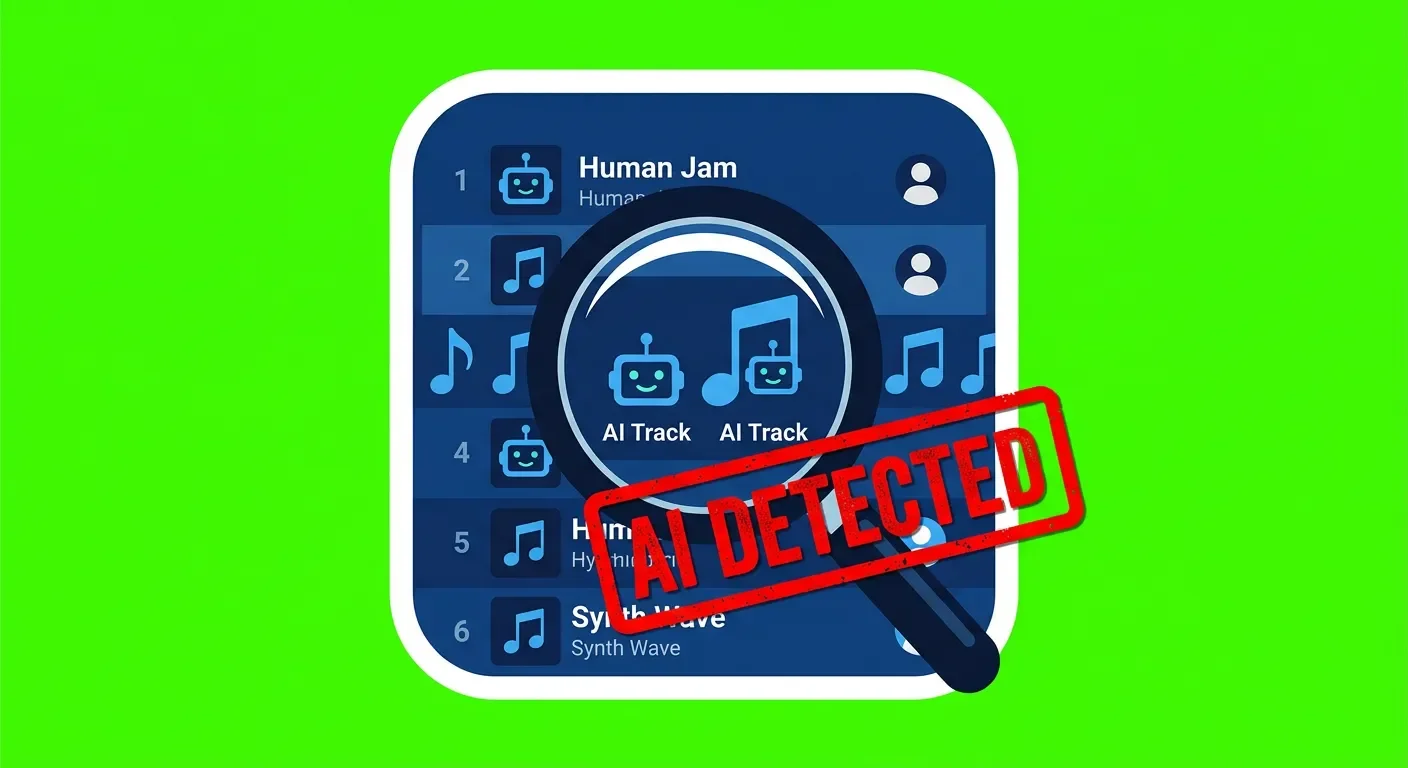
Deezer launched a free AI music detector on June 11 that lets Spotify and Apple Music users check their playlists for synthetic tracks. The technology works. The business logic is that 44% of Deezer's own daily uploads are AI-generated, 85% of streams on those tracks are fraudulent, and after 18 months of detection Deezer's policy response has been to hide AI tracks from playlists — not demonetize them. A roast of transparency-as-acquisition-funnel.

Daily AI Product Roast
2026/6/13 · 6:07
購読 1 件 · コンテンツ 7 件
"We were the first in the world to detect and tag AI-generated music. No other company has followed our lead yet." — Deezer CEO Alexis Lanternier, June 11, 2026
Deezer is a streaming platform that receives 75,000 AI-generated tracks per day. That figure accounts for more than 44% of its total daily intake.1 The platform has been watching this number climb since early 2025, knows that up to 85% of streams on those tracks are fraudulent, and can trace this to a specific set of generative models — Suno, Udio, and comparable tools.1
Its response, announced Thursday, is a free web tool that lets Spotify users, Apple Music users, and Amazon Music users check their playlists for AI-generated tracks.1

What Deezer actually built

The tool works like this: go to deezer.com/explore/ai-music-detector, connect your streaming account, let Deezer scan your playlists, see your results. It supports 20 platforms, runs in 27 languages, and is free to anyone. The detection technology is the same system Deezer uses internally, plus two patents filed in December 2024 for detecting synthetic audio signatures.1
Deezer also sells this same detection tech to other music-industry companies via business.deezer.com/ai-detection. The free consumer tool and the paid B2B license are the same underlying product at two different price points. The consumer version requires you to connect a streaming account — meaning Deezer sees which platform you're on, which playlists you have, and which specific tracks appear in them.

Deezer does not explain what it does with that data once the scan completes.

The numbers that make the pitch work

The press release contains the kind of statistics that generate headlines, so it's worth going through them carefully.
統計カードを読み込んでいます…
97% of survey respondents couldn't tell AI music from human music. This came from an Ipsos blind test that played two AI songs and one real song and asked people to identify the human track.1 That is a constrained test design — three options, two of which are the same category — and it does not translate directly to "AI music is undetectable in the wild." But it makes a good headline.
43% of users switching to Deezer from other platforms already have AI tracks. This is the hook that justifies the cross-platform tool. The logical inference is: Spotify's catalog has a lot of AI music in it too. Deezer didn't link to any methodology for how it counts this figure, but the number does the work of making competitors look negligent.
44% of Deezer's daily uploads are AI-generated. This is the number Deezer is most proud of tracking, and it is genuinely alarming if you think of it as a content-quality problem. If you think of it as a business problem, it suggests that Deezer spent 18 months building detection infrastructure while the underlying catalog continued filling with content it had to remove from recommendations.
Deezer's AI music detector landing page showing playlist scanning interface
Deezer's free detector supports 20 streaming platforms. Connecting your account gives Deezer a view of your playlist contents.1

The business logic here is not what it appears to be

Deezer is a small company. It is listed on Euronext Paris (ticker: DEEZR) and had roughly 550 employees as of the press release.1 Its two main competitors — Spotify (640 million users) and Apple Music — are orders of magnitude larger in user base.
The free cross-platform detector is straightforwardly a user-acquisition tool. The flow is: Spotify user scans their playlists, gets an "eye-opening experience" showing AI contamination, and is then positioned to consider Deezer as the platform that actually deals with this problem. The CEO's framing — "no other company has followed our lead yet" — is a direct competitive differentiation claim. Transparency as market positioning.
That is fine as far as it goes. Companies should be allowed to compete on having better practices. The issue is the framing as altruism. The press release describes the tool as making it possible "for everyone to check their library on their own, for free," as if the primary motivation were consumer welfare rather than a conversion funnel for a struggling streamer trying to differentiate from Spotify.

What the tool does not fix

The AI music problem on streaming platforms has two layers. The first is detection — identifying which tracks are synthetic. Deezer solved this, and its technology works. The second is incentive — why labels, distributors, and individual uploaders keep submitting AI tracks at industrial scale.
Deezer's answer to the second problem is that it removes AI tracks from algorithmic recommendations and editorial playlists. But it does not remove them from the catalog or stop paying royalties on them — it says it is taking "careful consideration" before "updating supplier policy and removing/demonetizing content."1 That careful consideration has been ongoing for 18 months while the daily upload rate compounded.
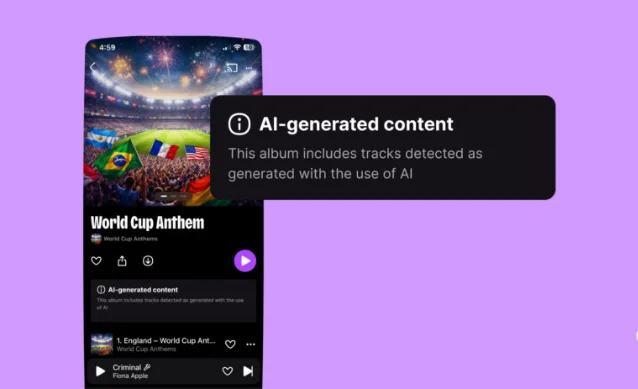
The scale of the fraud gets clearer when you look at adjacent data. When AI-generated World Cup anthems flooded streaming platforms ahead of the 2026 tournament, Deezer tagged 70% of them as synthetic — a wave of content designed to capture search traffic and royalty payments from a trending event, not to make music.2
Chart showing 70% of unofficial World Cup 2026 anthems on Deezer are tagged as AI-generated
70% of unofficial 2026 World Cup anthems on Deezer were tagged as AI-generated — an example of how AI uploads concentrate around trending topics to capture royalty streams.2
The detector tells you which tracks in your playlist are synthetic. It does not change the fact that 44% of everything uploaded to Deezer today is synthetic, or that 85% of streams on those tracks represent royalty fraud.1 A detector built on top of an unresolved pipeline problem is a better user interface for the same underlying situation.

Verdict

The detector works. The technology is real and the detection rate is credible. But Deezer built a fire alarm that it is now offering to neighbors whose houses are also on fire, while still billing tenants inside its own burning building. The cross-platform framing is smart PR and mediocre content governance dressed in consumer-advocacy language.
The actual news here is not the tool — it is the 44% number and the 18-month timeline. In 18 months of knowing that nearly half its daily uploads were synthetic and mostly fraudulent, Deezer's operational response was to exclude those tracks from editorial playlists. The user-facing detector is the product launch. The policy reform is still under careful consideration.
A CISAC study that Deezer cites estimates AI could eliminate up to €4 billion in creator revenue by 2028.3 Deezer knows this. It filed two patents to commercialize the detection technology. There is a version of this story where one company deciding to actually enforce a no-fraud policy forces the rest of the industry to follow. That version requires Deezer to stop carefully considering whether to demonetize content it already knows is fraudulent.

このコンテンツについて、さらに観点や背景を補足しましょう。

  • ログインするとコメントできます。